The Oldest Pub in England: What the Evidence Actually Says
England's oldest pub is a tangle of rival claims. Here is how Ye Olde Trip, Ye Olde Fighting Cocks and the other contenders stack up against the record.
On this page
There is no single provable answer to the oldest pub in England, but the strongest surviving claim belongs to the George Inn at Norton St Philip in Somerset, a late 14th-century inn built for the Carthusian monks of Hinton Charterhouse. The famous names on the signs, from Ye Olde Trip to Jerusalem to Ye Olde Fighting Cocks, mostly rest on much later dates than their lettering suggests. This guide weighs each claim, tells you where the contenders are, and explains how to read a pub's age for yourself.
The short answer, and why the claims conflict
Historic England's own assessment is blunt: many pubs claim the title, few can support it, and where evidence is absent the imagination fills the gaps. Its conclusion is that purpose-built medieval inns, which offered bedchambers, food and drink to travellers, survive best, which is why the George Inn carries the clearest weight. The traditional pub as you experience it today is mostly a 19th-century creation, with older alehouses, taverns and inns folded into later buildings.
The claims conflict because three different things get muddled: a site can be ancient while the building is not, a building can be old while the pub inside it is recent, and a pub can be old while trading under a different name. Add a landlord with a flair for marketing and you get today's rival dates. If a pub's own literature does not say which of the three it means, weight the claim accordingly.
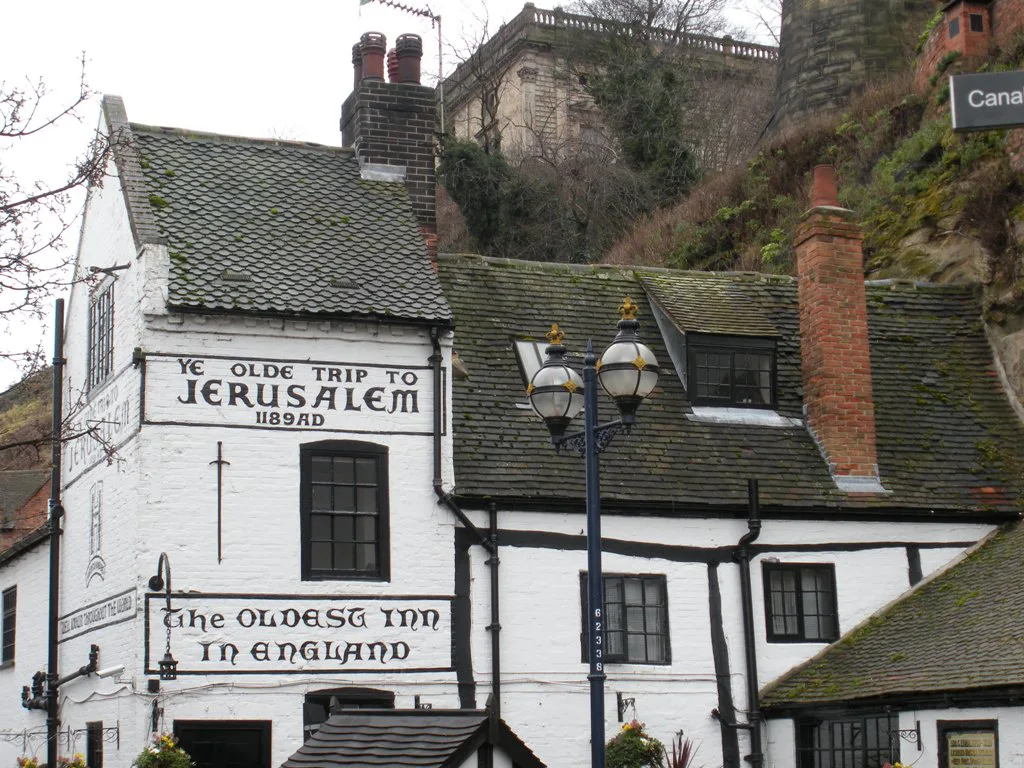
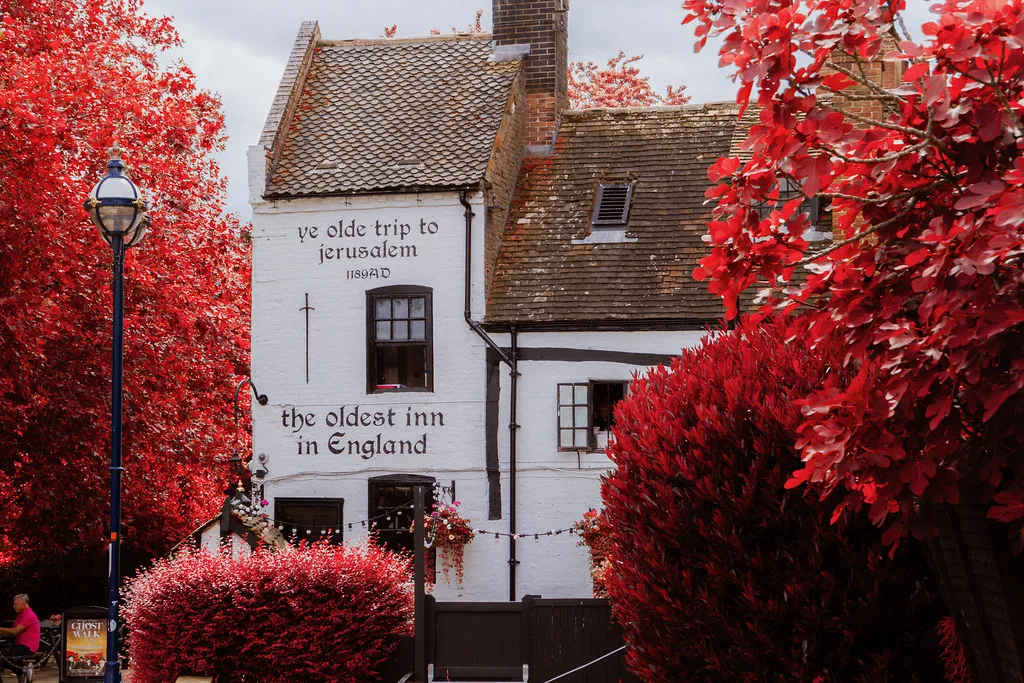
Ye Olde Trip to Jerusalem, Nottingham: the famous 1189 claim
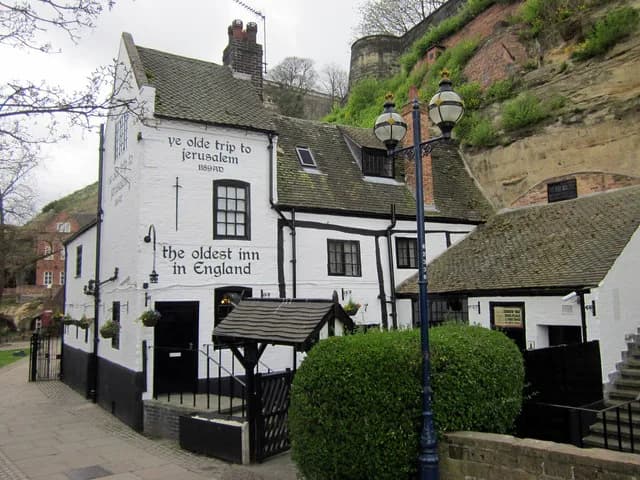
Ye Olde Trip to Jerusalem, tucked into Brewhouse Yard beneath Nottingham Castle, is the contender most people name first. It advertises itself as the oldest inn in England with a date of 1189, tied to the legend of crusading knights stopping en route to the Holy Land. Historic England's verdict is that the present building and caves were created in the 17th century, the earliest reference to a pub called the Pilgrim is from 1751, the name Trip appears by 1799, and the oldest-pub claim was pushed by a landlord around 1910 to draw trade.
None of that makes it a bad pub. The Ward room on the ground floor is partly cut into the sandstone rock, which is an unusual place to drink and the reason to choose this one over the others. Treat 1189 as pub folklore and enjoy the cave instead.
If you are in Nottingham for the history rather than the sign, the Bell Inn is a mid-15th-century building serving as a pub by the 1630s and has the better claim within the city. Order a sessionable cask ale, and go at lunchtime to see the rock room without a crowd.
Ye Olde Fighting Cocks, St Albans: a dovecote, not a Saxon inn
St Albans' octagonal timber-framed pub claims 793, but that date first appears on an early-20th-century postcard with no historic record behind it. The structure began as a dovecote of around 1400 at the nearby monastery, was rebuilt as a house on the present site around 1600, and was serving beer under the Fighting Cocks name by 1807. Choose it for a handsome building and a stroll around St Albans rather than a record.
If you are new to pub-going, ordering and seating are straightforward once you know the drill, so read up on pub etiquette UK before you go.
The Bingley Arms, Bardsey: the Domesday claim near Leeds
The Bingley Arms at Bardsey, just outside Leeds, has claimed early medieval origins and a Domesday mention, but no pubs are mentioned anywhere in the Domesday Book. What stands today is a good example of mid-18th-century West Yorkshire vernacular building with a surviving 1738 datestone. It remains a worthwhile village stop with an old-fashioned feel rather than a tourist attraction, best paired with a walk and a pint of real ale.
The Royal Standard of England, Beaconsfield: the freehouse claim
The Royal Standard at Forty Green, Beaconsfield, markets itself as the oldest freehouse in England and runs a website at theoldestpub.com, which tells you how much of the brand rests on the claim. What it offers is a warren of rooms and snugs with cask ales from Chiltern Brewery of Buckinghamshire and Rebellion of Oxfordshire, a fire, and a kitchen turning out fish and chips and pork belly with bubble and squeak.
It is dog-friendly and family-friendly, sits in Chiltern countryside with walks that stop here, and runs a quiz night on Tuesdays. It is also regularly hired for filming, so the pub's own page is the one to check before you travel.
The George Inn, Norton St Philip: the strongest surviving purpose-built inn
The George Inn at Norton St Philip, south of Bath, was built in the late 14th century for the Carthusian monks of Hinton Charterhouse so that merchants attending their markets and fairs had somewhere to stay. It is Grade I listed and is the strongest claim to be England's earliest surviving purpose-built inn, a different honour from the oldest pub and a more defensible one. This is the one most guides skip, which makes it the more rewarding visit: order a local bitter and look at the galleried courtyard before you order food, because the building is the point.
How to weigh an age claim yourself
Ask three questions in order. Is there a document, a datestone or a licence that names the pub? Does it refer to the building standing now or an earlier structure? And is there evidence the place has actually traded as a pub since that date? Medieval inns survive best because they were built to impress and outlast their owners, so galleried courtyards and wide street frontages are a better cue than a hand-painted 12th-century date.
A pub's own website is the right place to check kitchen times, booking and any closure for filming or a private event, because these change often. Last orders are the thing most likely to catch you out on the day.
Visiting the contenders: areas, rooms and what to order
If you are basing a day out on one claim, pick by setting: the Trip for the rock-cut Ward room in Nottingham, the Fighting Cocks for a timber-framed building in St Albans, the Bingley Arms for a Yorkshire village stop near Leeds, the Royal Standard for a Chilterns country pub with walks, and the George Inn for a Somerset village with a courtyard. Each is a short trip from its nearest town rather than a city-centre crawl, and in the country pubs it pays to book ahead for Sunday lunch.
For food, the classics do the work in this company: fish and chips, a Sunday roast, or a starter of something simple with a pint. Our guide to pub food explains what to expect from a starter and a main.
For more on the buildings and the names above their doors, our guide to English pub names and inn signs explains where names like the George and the Fighting Cocks come from, and it will make you a better reader of the sign outside.
Which contender should you actually visit?
For the most defensible history, head to the George Inn at Norton St Philip in Somerset: it is the closest thing to a factual answer about England's oldest inn, and it is a good pub in its own right. For the best story to tell afterwards, the rock-cut room at Ye Olde Trip to Jerusalem is the one worth the detour, with the 1189 date safely filed under pub folklore.
If you want the full run of contenders, the Royal Standard of England at Beaconsfield works best as a countryside day out with a walk attached. Check kitchen times on the pub's own site before you set off and book the Sunday lunch.
Explore more United Kingdom guides
Frequently Asked Questions
Is Ye Olde Trip to Jerusalem the oldest pub in England?
It claims 1189 on its signage, but the present building and caves date from the 17th century, and the oldest-pub claim was promoted by a landlord around 1910. The earliest reference to a pub on the site called the Pilgrim is from 1751. Even within Nottingham, the Bell Inn has the better documented claim as a pub by the 1630s.
What are the ten oldest pubs in England?
There is no agreed list, because a site, a building and a continuously trading pub are three different things. The clearest claim is the George Inn at Norton St Philip as the earliest surviving purpose-built inn, with other medieval inns such as the Angel and Royal at Grantham and the New Inn at Gloucester following. Beyond those, most top-ten lists mix authenticated inns with marketing dates.
Is the Royal Standard of England the oldest pub in England?
The Royal Standard at Beaconsfield describes itself as the oldest freehouse, which is a different claim from the oldest pub. It is a country pub with fires, a beer hall and rooms to settle in, useful as a Chilterns stop, rather than a demonstrably earlier building than the Somerset inns. Its own site is the place to check what is on.
Sources
Notes on eating out in the UK
Optional updates when our city guides change.
You might also like
Continue reading
More guides you'll find useful