
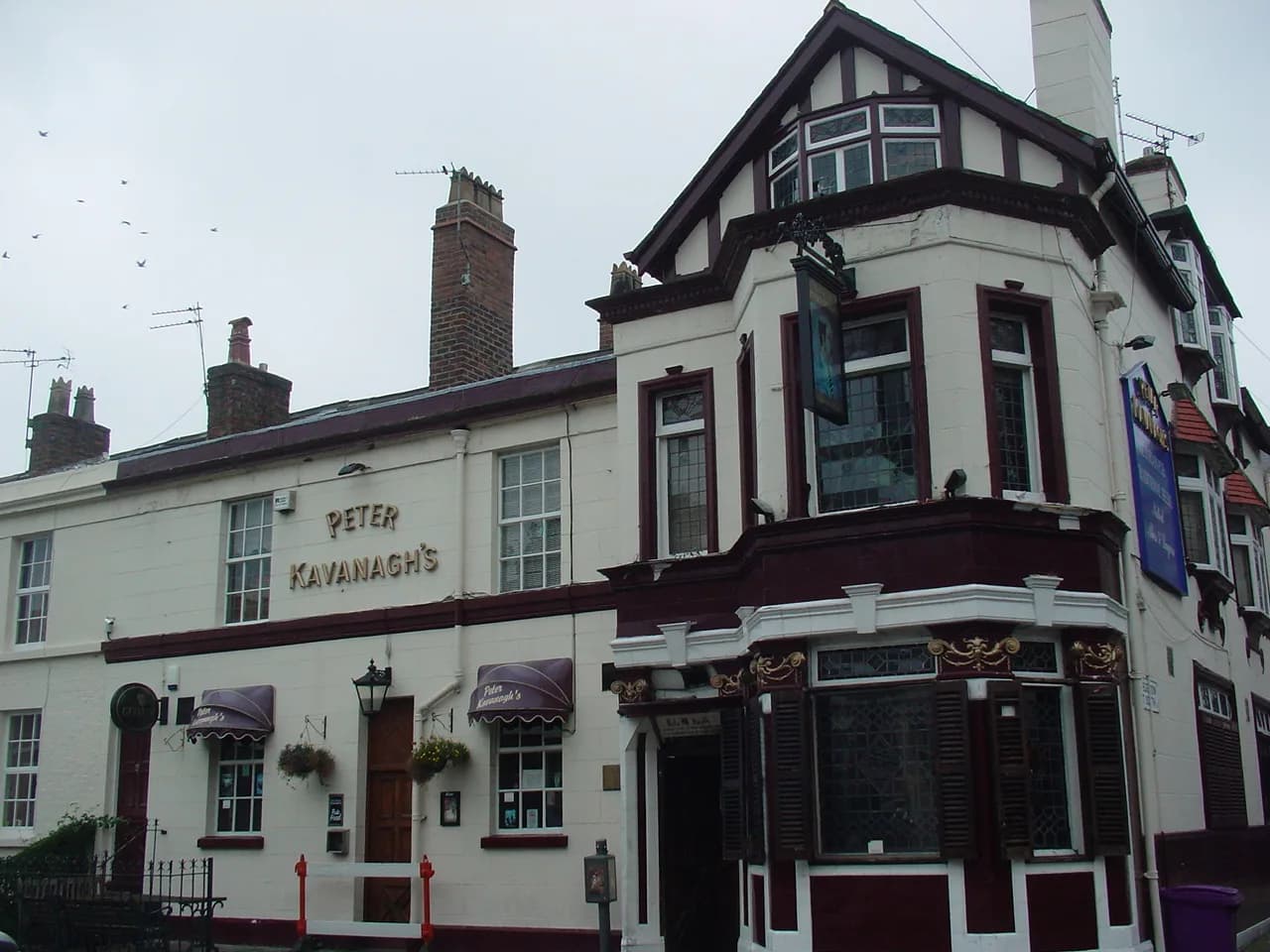
Peter Kavanagh's, Liverpool: Inside the 1929 Grade II Interior

Peter Kavanagh's is worth finding because of what happened inside it in 1929, not because of what is poured at the bar. The pub at 2–6 Egerton Street in Liverpool's Georgian Quarter holds a remodelled interior from that year, with murals by Eric Robinson and leaded glass by William English, and the building was listed at Grade II in 2020. This guide covers where it is, how to get there, which room holds which artwork, and how much time to give it.
Where Peter Kavanagh's is in Liverpool
The address is 2–6 Egerton Street, Liverpool, L8 7LY, on a terrace running through the Georgian Quarter south of the city centre. The nearest station is Liverpool Central, which puts the pub within a walkable radius of the main shopping and station district rather than out in the suburbs. Egerton Street sits among the Georgian terraces and later cultural buildings that give this part of the city its quieter, residential feel.
Walk it from Liverpool Central rather than planning a bus or taxi, and use the station as your compass point if you are coming from the Wirral or the northern lines. The approach on foot is part of the appeal: you leave the busy streets behind and arrive at a corner of the city that feels older and slower.
How to get there and how long to allow
Set aside around an hour if the interior is your main purpose. That covers reading the room, finding the murals in both spaces and looking up at the leaded glass, with time left over for a drink. Treat it as a short, focused stop rather than a half-day out, because the draw is the building and its decoration, not an exhibition or a tour.
Opening hours change with the season and with events, so check the times published for the date you plan rather than relying on a guide written earlier; the same applies to food and whether a table needs booking. The European Bar Guide's entry for Peter Kavanagh's is another place to look, though any listing can lag behind the pub itself.
The building: an 1840s terrace, Grade II listed
The pub occupies three houses of an early-1840s terrace, a modest domestic row rather than a purpose-built Victorian gin Palace. Number 2 was rebuilt around 1877, and the public house later absorbed numbers 4 and 6, which explains why the interior runs through more than one frontage. The building, including those neighbouring numbers and its cast-iron railings, was listed at Grade II on 30 January 2020 under NHLE 1468405, as recorded in the Old Town Liverpool feature on the pub.
Knowing about the listing changes how you look at the place. The railings outside and the join between the houses are as much part of the protected whole as the panelling within, so look up and look back at the frontage before you go in. It also explains why the layout feels domestic and slightly irregular rather than open-plan.
Inside: the Dickens and Hogarth murals
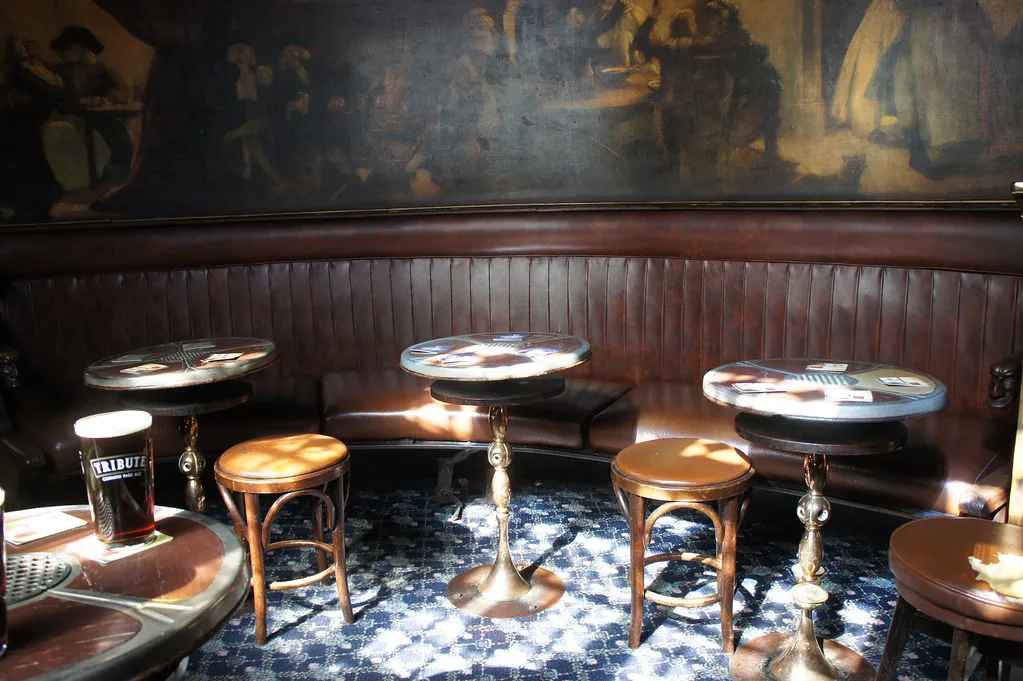
Start in the front room, where Eric Robinson painted murals based on Charles Dickens; the rear room holds his Hogarth-inspired work. Robinson was a Scottish artist, and his 1929 scheme is the single best reason to make the trip. Look at the walls as a pair rather than as separate decoration, because the two rooms were intended to read together as part of one remodelling.
Give yourself time to take in the glass as well as the paint. William English made the leaded glass with maritime scenes, and the carved oak runs to corbels and panels showing 18th-century drinking scenes, with heads cut into the bench armrests. First-time visitors often fix on the murals and miss the woodwork entirely.
Carved oak and leaded glass to look for
The wooden detail is easy to walk past, so treat it as a checklist. Find the corbels where the structure meets the ceiling, the carved panels of period drinking scenes, and the small heads on the ends of the bench armrests. Together they show how far a 1920s refit could reach into the fittings as well as the surfaces.
The maritime leaded glass gives the rooms a different light from the painted panels, and it is worth comparing a front-room window with one towards the rear. If the pub is busy, standing rather than sitting can make the upper areas easier to study without blocking anyone.
Who Peter Kavanagh was
The pub is named for a man who ran it for more than half a century. Peter Kavanagh took over in 1897, bought the building outright in 1928 and stayed licensee until his death in 1950, which is a remarkable stretch for one landlord in one house. The 1929 interior was his project, so the murals and glass are effectively his memorial.
That continuity explains why the pub feels like a single person's taste rather than a committee's. The Hogarth scheme at the rear and the Dickens work in front were commissioned by one licensee with strong ideas and the money to carry them out.
The Liver, the Grapes and the absorbed neighbours
The building's names have changed more often than its fabric. Number 2 was first licensed in 1854 as The Liver, was rebuilt around 1877 as the Liver Hotel and became The Grapes in 1892 before settling into the Kavanagh name. Numbers 4 and 6 came into the pub in the 1960s and 1970s, which is why the address now reads as a run of three.
Keeping those dates straight helps when you read older accounts of the pub, some of which describe a building that has since been altered or extended. The core story is simple: a mid-Victorian terrace, a late-Victorian rebuild, a name change, and then a 1920s refit.
What's nearby in the Georgian Quarter
The pub sits in a quarter dense with other historic drinking houses, which makes a short crawl the natural way to use it. The Philharmonic Dining Rooms and Ye Cracke are both in the same part of the city and each rewards a stop in its own right. Planning two rather than three keeps the day about looking rather than moving.
To compare the named places one by one, browse Liverpool pubs and food landmarks. Keep the pub as the anchor and let the surrounding streets fill the time either side.
When to go and what to confirm first
Late afternoon tends to suit a building-focused visit, when the rooms are easier to read and you are not competing for space. Evenings will bring a different atmosphere and a different crowd, so decide which you want before you set off.
Hours, food and booking arrangements can change and are not fixed here. Check the pub's own published details before you travel, and treat third-party listings as a starting point rather than a guarantee.
Is Peter Kavanagh's worth the detour?
Yes, if you care about interiors and are already in the city centre. The 1929 murals, the maritime glass and the carved oak together justify a short walk from Liverpool Central, and the Grade II listing confirms you are looking at something officially recognised rather than merely old.
No, if you are after a full meal, a long session or a ticketed attraction. There is no exhibition and no guided tour, so pair it with the Philharmonic Dining Rooms or another stop in the quarter and it earns its place.
Explore more Liverpool guides
Frequently Asked Questions
Do I need to book to see the interior of Peter Kavanagh's?
It is a working pub, so there is no separate ticket for the rooms and no booking system for looking at the murals. Whether a table needs reserving depends on the day and on whether food is being served, so check the pub's own published details before you go.
Are the murals and leaded glass original?
They date from the 1929 remodelling commissioned by Peter Kavanagh, with murals by Eric Robinson and leaded glass by William English. The building itself is older, built as an early-1840s terrace and rebuilt around 1877, so the decoration is a 1920s layer on a Victorian shell.
How far is it from Liverpool Central station?
Liverpool Central is the nearest station to the pub on Egerton Street, and the walk takes you into the Georgian Quarter south of the main shopping district. Allow a little extra time if you are unfamiliar with the streets.